To start page
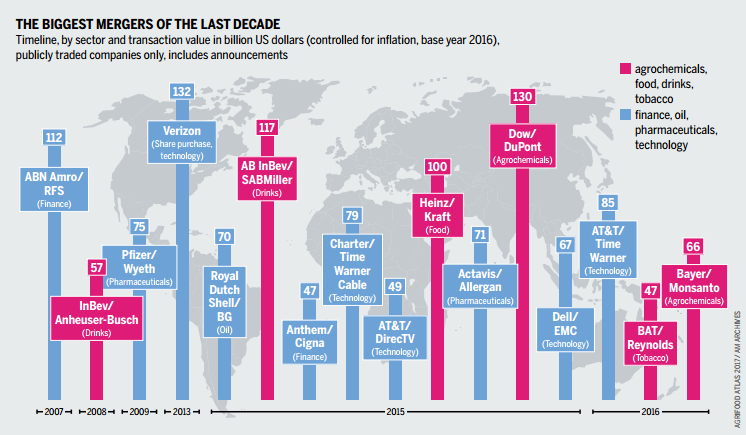
Takeovers and mergers like Monsanto by Bayer, Kraft with Heinz and Dow with DuPont are just the tip of the iceberg. A spate of corporate marriages is concentrating control at each link in the value chain, from field to fork. The biggest players are growing the fastest and are pushing through their own interests and approaches. When does big become too big? That is not an easy question to answer. Attention to ecological and social values such as human rights, labour rights, as well as climate and environmental protection does not necessarily depend on the size of a company. But in many parts of the agrifood sector, individual corporations have gained so much market sway that they have the ability to shape markets and policies. Conflicts usually involve unequal power relations: between agricultural, food and trade corporations on the one hand, and farmers and farm workers on the other. The gap between their shares of revenues yawns ever wider. Across the globe, inequality is increasing.
Agrifood corporations are driving industrialization along the entire global value chain, from farm to plate. Their purchasing and sales policies promote a form of agriculture that revolves around productivity. The fight for market share is achieved at the expense of the weakest links in the chain: farmers, and workers. The price pressure exerted by supermarkets and food firms is a major cause of poor working conditions and poverty further back in the chain. It also promotes the onward march of industrial agriculture and its associated effects on the environment and climate. The loss of soil fertility and biodiversity, marine pollution and the emission of greenhouse gases: all these are partly due to the spread of industrial farming. Despite all this, a reorientation is still not in sight – except in a few promising cases. On the contrary, attempts to make binding rules on human rights, working conditions and the environment are routinely torpedoed. A major reason lies in the power relations described in this atlas. To push for the necessary political changes, we first need to understand the business models and growth strategies of the corporations.